
Imagine a country that hands you a world-class engineering degree, almost for free, and then opens the door to a six-figure career. That is Germany's promise to ambitious students today.
For years, many Indian students chased the US and UK dream, often drowning in debt. Germany flips that script.
Public universities in Germany charge little to no tuition. The industries are hungry for skilled talent, and degrees offered carry serious global weight. No wonder in every intake, thousands of Indian students now choose to study in Germany.
This blog breaks down exactly how the free-tuition system works, what the blocked account really means, and how the visa process unfolds step by step. Whether you are eyeing a master's, an MBA, or a PhD, this guide gives you the practical roadmap you actually need.
Germany has quietly become one of Europe's most attractive study destinations. It combines academic rigor with real affordability, something rare in Western higher education.
Public universities dominate the landscape, and most charge zero or minimal tuition. That single factor changes the financial equation for families back home.
Add to this a booming job market in engineering, automotive, IT, and manufacturing, and the appeal only grows stronger.
For students who want quality education without crushing debt, choosing to study in Germany simply makes financial sense.
Yes, largely. Public universities in most German states charge no tuition fee at all, even to non-EU students. This policy has held steady across the majority of federal states.
That said, students still pay a mandatory semester contribution, known as Semesterbeitrag, which typically ranges between €100 and €400 per semester. This covers administrative costs, student services, and often a public transport pass.
One state, Baden-Württemberg, and some programs at institutions like TUM in Bavaria, do charge non-EU students a modest tuition fee, usually between €1,500 and €3,000 per semester.
It is still far cheaper than private alternatives.
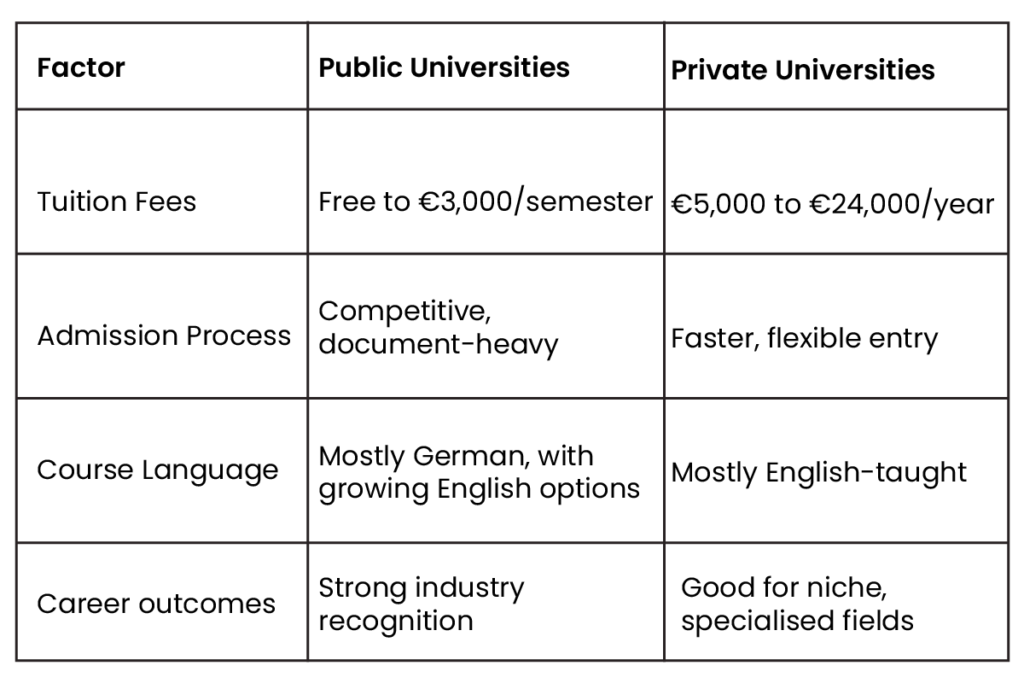
Public universities are state-funded and prioritise research and affordability. Private universities in Germany charge more but offer smaller batches and industry-focused curricula.
Germany's academic strength lies heavily in technical and research-driven disciplines, though business and management programs are catching up fast.
A Master's study in Germany typically spans two years and is offered in fields ranging from mechanical engineering to data science.
Many programs are entirely taught in English now.
For leadership roles, Germany MBA fees at public universities stay reasonable compared to the US or UK, often under €10,000 total at select institutions.
Research-driven students often pursue a PhD in Germany, which is usually funded through research assistantships or scholarships, making it financially viable and academically prestigious.
Choosing between public and private institutions comes down to budget, course availability, and career goals.
Here's a quick comparison to simplify that decision.
Among Germany's best universities, names like TUM, LMU Munich, and Heidelberg University consistently rank at the top for both academics and employability.
Funding a degree abroad rarely rests on tuition alone, since living costs still add up. Fortunately, scholarships in Germany are fairly accessible if you know where to look.
Applying early, ideally six to eight months before intake, significantly improves your chances of securing funding.
A blocked account, or Sperrkonto, is a special German bank account that proves you can financially support yourself during your stay.
You deposit a fixed amount upfront, and the German authorities restrict how much you can withdraw each month. This prevents financial distress and satisfies visa officers.
Presently, the required blocked account amount stands at approximately €11,904 annually, translating to roughly €992 per month. This figure is reviewed and adjusted periodically by German authorities.
Providers like Fintiba and Expatrio handle this entirely online, and the process typically takes four to six weeks from opening to receiving confirmation.
Without this Sperrkonto confirmation letter, your visa application simply will not move forward. It is non-negotiable.
The German visa application process has become more digital-friendly recently, but it still demands precision and early planning.
Once documents are ready, applicants upload them through Germany's digital consular portal before booking an in-person appointment.
At the appointment, a visa officer conducts a short interview, verifying your intent, funding, and academic plans. This is where clarity and confidence really matter.
The German visa for students falls under the National Visa (Type D) category, with a processing time of roughly six to twelve weeks.
For most applicants pursuing a German visa from India, approval rates hover around 90 to 95 percent, provided documentation is complete and accurate.
Budgeting for Germany involves more than just tuition. Living costs, insurance, and the blocked account all factor into your total spend.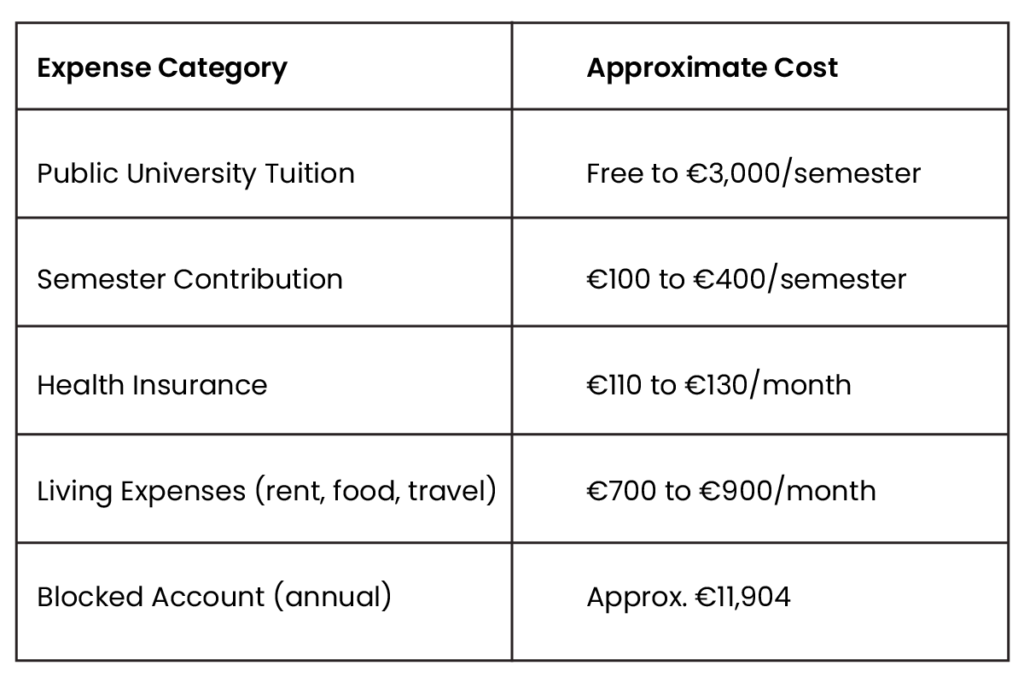
Overall, students should budget somewhere between €900 and €1,200 per month to live comfortably in most German cities.
Applying to German universities follows a fairly structured sequence, and skipping steps often causes delays.
Students exploring options to study abroad in Germany often underestimate timelines, so starting six to nine months ahead is strongly advised.
Speaking of timelines and paperwork, we know firsthand how overwhelming this entire process can feel when you're managing it alone.
At WIKATI Education, we help students shortlist the right German universities based on their profile, budget, and career goals, not just rankings.
Our team handles everything from SOP refinement to application submission, so nothing slips through the cracks during a competitive intake cycle.
I also guide students through blocked account setup and the entire visa documentation process, reducing the stress that usually comes with last-minute surprises.
When it comes to funding, I help identify relevant scholarships and government-backed options that students often miss on their own.
As one of the best abroad education consultants in India, WIKATI Education has supported thousands of students across destinations, and Germany remains one of our strongest success stories.
Q1: Can Indian students study in Germany for free?
Yes, most public universities in Germany charge no tuition fee, even for international students, though a small semester contribution still applies.
Q2: What is a blocked account in Germany?
It's a special bank account where you deposit funds upfront to prove financial capability, with fixed monthly withdrawals allowed during your stay.
Q3: How to apply for Germany student visa from India?
You need admission proof, APS certificate, blocked account confirmation, and insurance, then apply through Germany's digital consular portal before your appointment.
Q4: Are scholarships available in Germany?
Yes, options include DAAD scholarships, Deutschlandstipendium, and university-specific merit awards, covering tuition, living costs, or both partially.
Q5: Is Germany good for master's and PhD programs?
Absolutely. Germany offers globally recognised master's and PhD programs, often research-funded, with strong industry connections and affordable tuition.
Q6: How much does a blocked account cost in 2026?
The required amount stands at approximately €11,904 annually, roughly €992 per month, as mandated by German immigration authorities.
Germany continues to stand out as one of the smartest choices for Indian students seeking affordable, high-quality education abroad.
Between free public university tuition, strong research opportunities, and excellent career prospects, the appeal is hard to ignore. The path does require careful planning, from blocked accounts to visa documentation, but none of it is impossible with the right guidance.
Ready to turn your Germany plans into reality? Partner with WIKATI Education today and take the first confident step to study in Germany.
© Copyright WIKATI Education Services LLC