
One stamp for your visa decides your entire year abroad: it pays to get it right the first time.
Every intake, thousands of Indian students book flights before their visa is even lodged. That confidence only holds up when the paperwork behind it is airtight. Through 2026, Australia tightened its rules around student applications, and 2027 will demand even more precision from every applicant.
If you're planning to study in Australia, the fees, documents, and processing steps matter more than ever this year. This guide walks through exactly what the Australian student visa involves, without the hassle.
The Australian student visa is officially known as Subclass 500. It allows international students to live in Australia while completing a full-time course at a registered institution.
This single visa category covers university degrees, vocational diplomas, and English-language programs. It replaced several older visa types in 2016, simplifying the system for everyone involved.
Most Indian applicants sit under the higher-education stream. Your course provider, intake date, and financial documents all shape how Home Affairs reviews your Australia visa application.
The visa usually runs for your full course length, plus a short buffer. Family members can join as dependents on the same application, provided you meet income and accommodation criteria.
Australia raised its national student cap to 295,000 places for 2026, a 9% jump from the previous year. Yet approval patterns for Indian applicants shifted sharply through the same period.
Indian visa grants reportedly fell by a wide margin through mid-2026, as authorities placed India in a higher scrutiny tier. That doesn't mean fewer opportunities; it means documentation now carries more weight.
Hyderabad continues sending a steady stream of applicants to Melbourne, Sydney, and Adelaide campuses each intake. Local counsellors here have watched genuine student statements become the single biggest factor behind approvals.
For any Hyderabad-based student, this shift makes early planning essential. A rushed application, filed without proper evidence, now carries real rejection risk in 2027.
Filing this application isn't complicated, but the sequence matters. Miss a step, and your whole timeline slips backward.
Followed carefully, this sequence keeps your Australia visa application moving without avoidable delays.
Every requirement for student visa approval traces back to proving genuine intent and sufficient funds. Home Affairs checks each document against the others for consistency.
The table below summarises what to prepare and why each document matters.
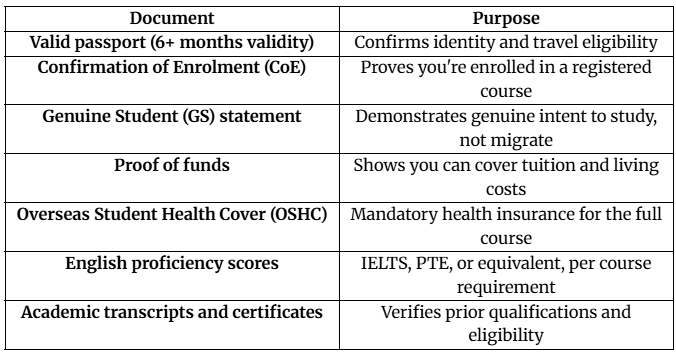
Missing even one of these documents can trigger a request for more information, adding weeks to your file. Consistency across every document matters just as much as completeness.
The headline number changed for everyone. From 1 July 2026, the base visa fee rose to AUD 2,500, up from AUD 2,000 the year before, roughly a 25% jump.
This fee covers the primary applicant only. Additional family members on the same application pay separate charges, so budget accordingly before you begin the process.
Beyond the core visa fee, students should budget for OSHC premiums, biometric costs, and optional priority processing. None of these are optional line items; they're the real cost of studying abroad.
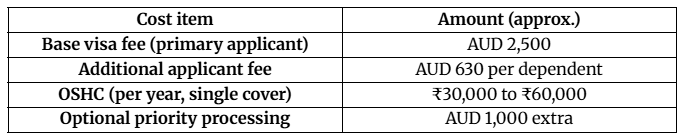
Currency swings between the rupee and the Australian dollar can shift your total budget by a few thousand rupees either way. Locking in funds early, through a fixed deposit or education loan, removes that uncertainty from your planning.
Most Indian applicants can expect their Australia student visa to be processed within 4 to 6 weeks, provided documentation is complete on the first submission.
That window isn't guaranteed, though. Files with unclear GS statements, inconsistent bank records, or missing OSHC details routinely take longer, sometimes stretching well past that range.
Filing early, ideally three to four months before intake, gives you a genuine buffer. It also leaves room to fix any document requests without threatening your enrolment date. For the latest visa information for Australia, always check the Home Affairs processing tool before you submit.
Evidence Level classifications also affect timelines. Since January 2026, Indian applicants have generally sat under a higher evidence tier, meaning officers expect more supporting detail before approval. This shift is worth discussing with your counsellor before you file, since it changes how thick your document file should be. Students who plan around it rarely feel the slowdown.
Yes. This visa currently permits part-time work during term and full-time work during scheduled breaks, subject to visa conditions.
This work right helps offset living costs and adds valuable local experience. Conditions can shift with policy updates, so always confirm current hour limits before accepting a job offer.
Working legally under your student visa also strengthens your case for future skilled or graduate pathways, if that fits your longer-term plan.
These work rights make Australia genuinely attractive beyond the classroom. Many students use term breaks to build local references, which helps later job applications after graduation.
Reading through GS statements, OSHC policies, and shifting fee tables can feel overwhelming, especially when rules change mid-year.
At WIKATI Education, we've spent over 13 years turning exactly this kind of complexity into a clear, manageable checklist for our students. Our counsellors are British Council and PIER certified, and we've guided more than 15,000 students into universities across six countries.
Our vision has always been simple: studying abroad should feel exciting, not stressful. That's why we maintain a 98.6% visa success rate, built on careful documentation and honest guidance from day one.
For Hyderabad families specifically, we review every GS statement personally before submission, and we help structure education loans up to ₹85 lakhs with zero collateral. Funds should never be the reason a strong offer falls through.
We've also watched policy shift fast enough to catch families off guard, which is exactly why our counsellors stay updated on every Home Affairs announcement as it happens.
2027 will reward students who prepare early and document carefully. The Australian student visa process hasn't grown harder to understand; it's simply grown less forgiving of shortcuts.
Get your CoE, draft an honest GS statement, secure your OSHC, and file with confidence. That's the entire game, played well.
Start your Australia student visa journey with WIKATI Education today.
This visa falls under Subclass 500, covering university, vocational, and English-language courses for full-time international students in Australia.
The base fee is AUD 2,500 per primary applicant, up from AUD 2,000, effective 1 July 2026, plus OSHC and optional priority processing charges.
Most Indian applicants receive a decision within 4 to 6 weeks, though incomplete documentation or unclear GS statements can extend this timeline considerably.
Yes, this visa allows part-time work during term and full-time work during scheduled breaks, subject to current visa conditions.
You'll need a CoE, GS statement, OSHC policy, proof of funds, academic transcripts, English scores, and a valid passport among the core requirements for student visa approval.
No, GTE was replaced by the Genuine Student requirement in March 2024, though it serves a similar purpose within the Australian visa application.
WIKATI Education maintains a 98.6% visa success rate across 15,000+ placements, built on careful documentation review and honest, experience-based counselling.
© Copyright WIKATI Education Services LLC