
You just graduated, and everyone says you need "at least two years of work experience" to pursue an MBA. What if that's simply not true?
A growing number of countries, especially in Europe, now welcome fresh graduates into world-class MBA and management programmes. Whether you're eyeing the UK's legacy business schools, Germany's affordable excellence, or Europe's diverse academic landscape, there is a path for you. You just need to know where to look.
This guide breaks it all down: destination by destination, cost by cost, and myth by myth.
Traditional MBA programmes, especially in the US, are built for mid-career professionals. Most expect 3–5 years of work history.
But Europe operates differently.
Many European institutions have developed specialised programmes for graduates who want business education right after their bachelor's degree. These include:
These aren't consolation prizes. They're globally ranked, industry-respected, and increasingly preferred by leading employers.
When students think of studying in the United Kingdom, they picture centuries-old campuses, global alumni networks, and top-tier faculty. They're not wrong.
The UK is home to some of the best universities in the UK for business education: institutions like the London Business School, Warwick Business School, Imperial College Business School, and the University of Manchester Alliance Manchester Business School.
Most UK institutions do not require work experience for a Master's in Management in the UK. These programmes are specifically designed for students 0–2 years out of their undergraduate degree.
MBA colleges in the UK offering pre-experience routes include:
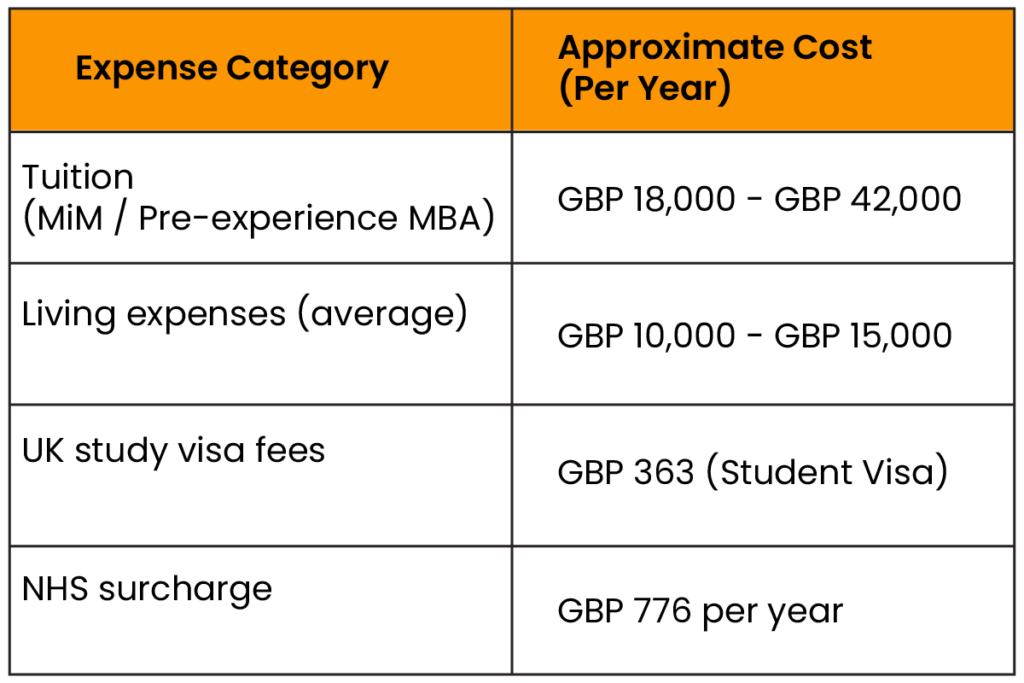
When you decide to study in the UK, you also gain access to the Graduate Route visa, giving you 2 years post-study work rights, which is a significant career launchpad.
Germany is quietly one of the smartest choices for ambitious graduates, and it's vastly underrated among Indian students.
The best universities in Germany for business and management include:
Master's studies in Germany at public universities come with one extraordinary advantage: tuition is free or nearly free, even for international students. Public institutions charge only a semester contribution of EUR 150–350, which covers admin, transport passes, and student services.
If you're looking to study in Germany without the financial burden of a six-figure loan, this is a game-changer.
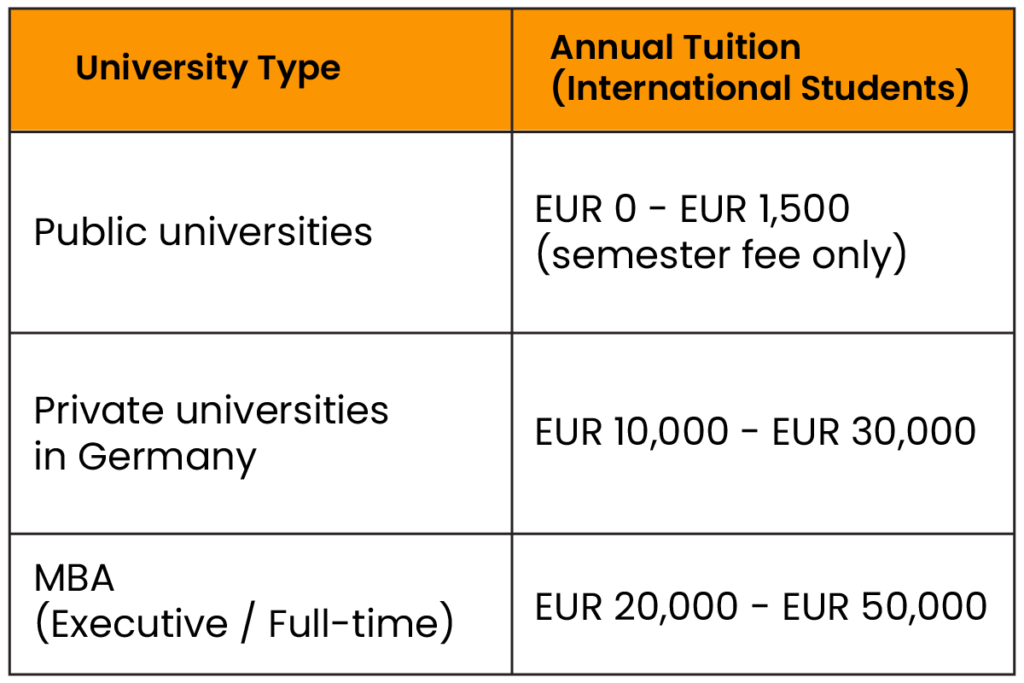
Study abroad in Germany is growing among Indian students due to the post-study work visa (Job Seeker Visa), which allows 18 months to find employment after graduation.
When we talk about options to study in Europe, the conversation goes well beyond two countries. Several European nations are actively courting international fresh graduates with competitive offerings.
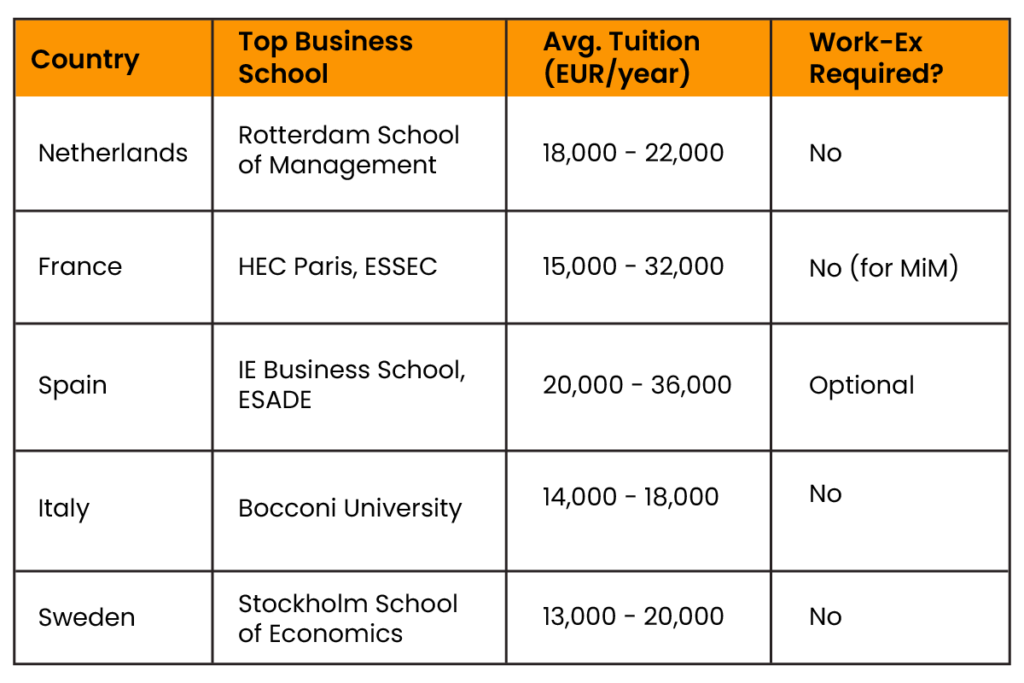
France's Grandes Écoles are particularly prestigious. HEC Paris's MiM programme consistently ranks in the global top 5. The Netherlands offers the Schengen advantage, meaning you can travel across 26 countries freely during your studies.
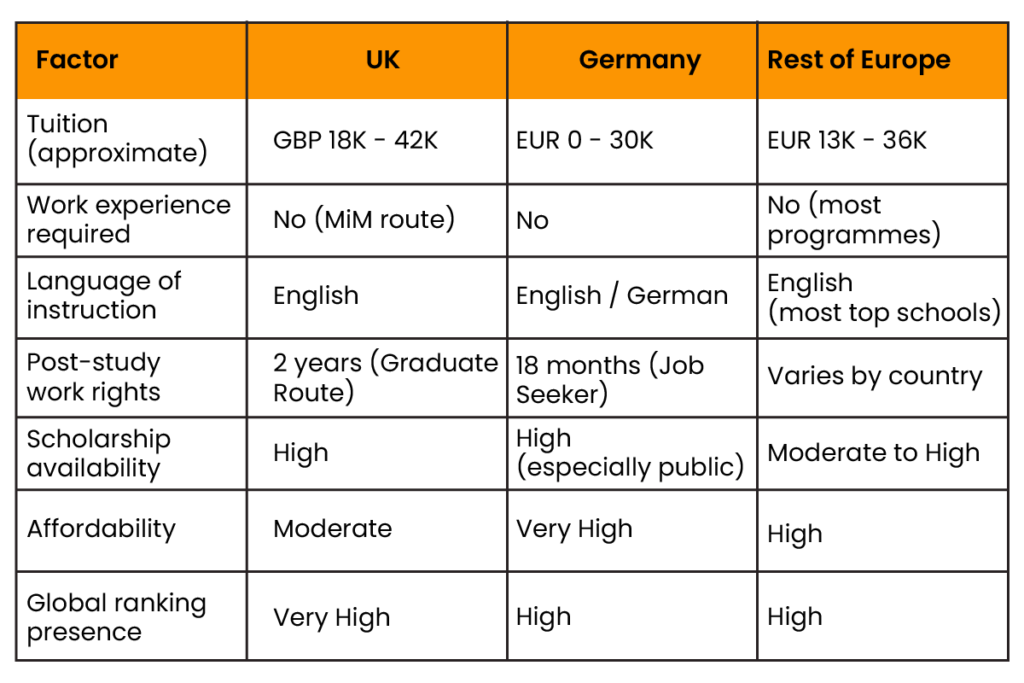
The right destination depends on your academic profile, budget, career goals, and the industry you want to enter. There is no universal winner: only the right fit for you.
Money is always a concern. Here's the good news: fresh graduates are among the most scholarship-eligible candidates in Europe.
For UK-bound students:
For Germany-bound students:
For broader Europe:
Strong academic records, compelling statements of purpose, and early applications significantly improve your chances.
No work experience doesn't mean a weak application. Admissions committees know exactly what a fresh graduate looks like, and they have different evaluation criteria for you.
What matters most:
Letters of Recommendation: Ideally, from professors who know your academic depth
Internships, in particular, are treated as professional experience in most European applications. If you've completed even a 3-month internship, lead with it.
At this point, you likely have one question: where do I actually begin?
That's where we come in.
At WIKATI Education, we have spent over 13 years guiding ambitious students from India toward their study abroad dreams, and we know that the journey from graduation to a European business school can feel overwhelming. It doesn't have to be.
As your trusted foreign study consultant, we don't just hand you a list of universities. We understand your academic profile, your financial situation, and your long-term career goals, and then we build a personalised roadmap: one that gives your application the best possible chance of success.
Our team handles everything: shortlisting universities, preparing your application documents, writing your SOP, processing your visa, and even helping with loan guidance and pre-departure orientation. We are your education consultant abroad, your personal guide from the day you say "I want to study in Europe" to the day you land at your destination university.
More than 15,000 students have trusted WIKATI Education with their futures. It's your turn.
Pursuing an MBA without work experience is not a compromise. In Europe, it's a strategy, and one of the smartest ones a fresh graduate can make.
The UK offers prestige, global recognition, and strong post-study work rights. Germany delivers world-class education at near-zero cost. And across Europe, dozens of top-ranked institutions are actively looking for ambitious young graduates just like you.
The only thing standing between you and your MBA abroad is clarity, guidance, and the right first step.
Ready to take the next step? Book your free consultation with WIKATI Education today: your trusted education consultant abroad for MBA and master's studies in Germany, the UK, and beyond.
Yes. Many UK universities offer Master's in Management or pre-experience MBA programmes specifically designed for fresh graduates with 0–2 years of experience.
Yes. Public universities in Germany charge only a semester fee of EUR 150–350. International students are eligible, and English-taught MiM programmes are widely available.
An MBA targets mid-career professionals with significant work history. A MiM is designed for fresh or early-career graduates and focuses on building foundational business and management competence.
The UK offers a 2-year Graduate Route visa. Germany provides an 18-month Job Seeker Visa. Both are strong; the right choice depends on your target industry and preferred location.
Very important. Since work experience is absent, GMAT or GRE scores carry more weight. A GMAT score of 650+ is a strong baseline for competitive programmes across Europe.
© Copyright WIKATI Education Services LLC