

Your tuition might be zero, but your rent won’t be. The city you pick will shape your budget more than your university ever will.
If you plan to study abroad in Germany in 2027, here is the short answer. From cheapest to most expensive, the eight cities we compare are Chemnitz, Leipzig, Dresden, Aachen, Cologne, Berlin, Frankfurt, and Munich. A student in Chemnitz can live on roughly €750 to €850 a month, while Munich usually needs €1,250 to €1,450. That gap adds up to ₹5 lakh or more a year, which is why we always tell families to choose the city as carefully as the course.
At Wikati, we have guided thousands of Indian students who want to study in Germany, and the same question comes up in nearly every first meeting: “How much will I actually spend each month?” This guide gives you honest numbers, city by city, so you can plan with your eyes open.
The figures below are estimated all-in monthly costs for a single student in 2027. They cover rent in a shared flat or student dorm, food, health insurance, the semester ticket, a phone plan, and a bit of personal spending.
We have converted euros at about ₹110 per euro, so please check the live rate when you budget, since it moves every day.
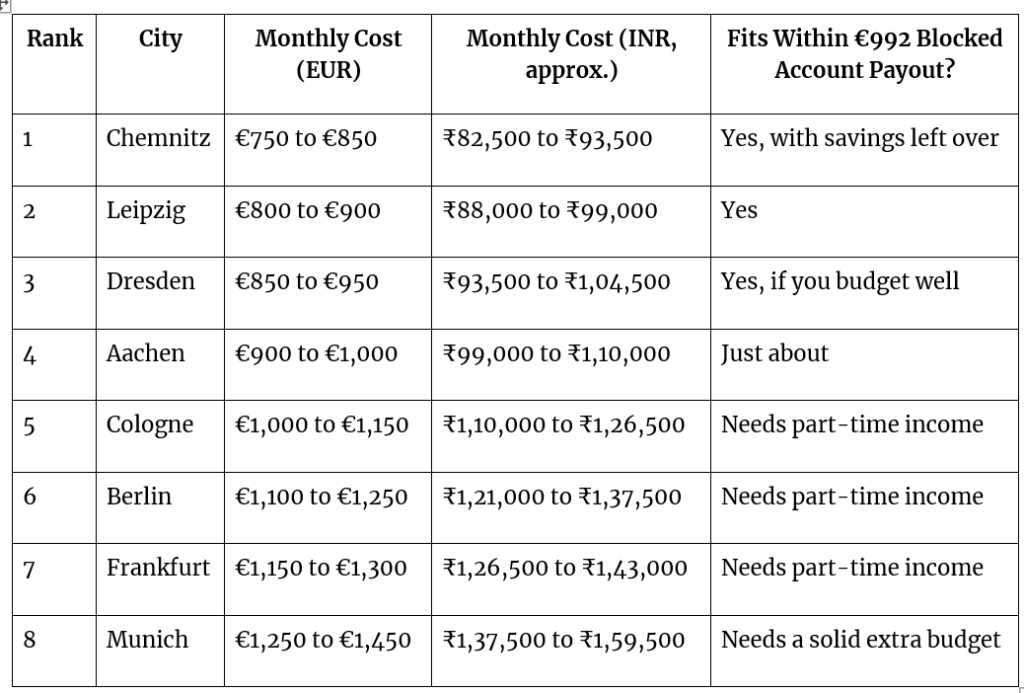
Rent is almost the whole story here. Food, insurance, and transport cost roughly the same across the country. A room in Munich can cost twice what a similar room costs in Leipzig, and that single line decides where a city lands on this list.
Chemnitz is the quiet budget champion. If saving money matters most to you, this is the city to look at first.
Leipzig gives you a lively student scene without big-city rent. Many of our students call it the best balance of cost and lifestyle in the country.
For anyone weighing a master study in Germany in engineering or electronics, Dresden offers a top-tier university at a fair price.
Aachen is a great pick for mechanical, automotive, and production engineering students who want a big-name university without Munich prices.
Cologne is friendly, open, and easy to settle into. The rental market is tight, so start your housing search early.
Berlin is the easiest German city to live in without fluent German. The catch is housing, which can take weeks or even months to secure.
Frankfurt suits finance, economics, and business students who want to build industry contacts while they study.
Munich offers world-class universities and careers, but it’s the most expensive city on our list by a clear margin. Plan for it, and it can be worth every euro.
A low monthly cost is great, but it shouldn’t be the only thing you weigh. Over the years, we have seen students save money in a small city and then struggle to find internships, and we have seen others stretch themselves thin in Munich without a backup plan. The sweet spot sits somewhere in between.
Here is the simple framework we use with our students:
One more tip. Your course should always come first, and the city second. A cheaper city only makes sense if it offers the program you actually want. Any good study abroad plan starts with the degree, then checks whether the city fits your wallet. If two universities offer a similar program, that is when the cost table above becomes your best tie-breaker. Our university finder can help you compare programs side by side.
Every non-EU student needs proof of funds, and most Indian students provide this through a blocked account, also called a Sperrkonto. For 2026, the required amount is €11,904 per year, which works out to €992 per month. This figure has stayed the same since late 2024. Providers expect it to carry into 2027, but it’s tied to Germany’s BAföG rates and can change, so we always confirm the latest number with the embassy before you deposit.
Here is why this matters for your city. Once you arrive, you can only withdraw €992 each month. In Chemnitz, Leipzig, or Dresden, that payout can cover your full monthly cost. In Cologne, Berlin, Frankfurt, or Munich, it usually won’t, and you will need family support or part-time income to fill the gap. If you need help funding the blocked account, our overseas education loan assistance can support you.
Part-time work does help. International students can work 140 full days or 280 half days a year, and Germany’s minimum wage is set to rise to €14.60 per hour from January 2027. Even so, we advise students never to plan a budget that depends on finding a job in the first month. For the full checklist, read our guide to Germany student visa requirements and costs.
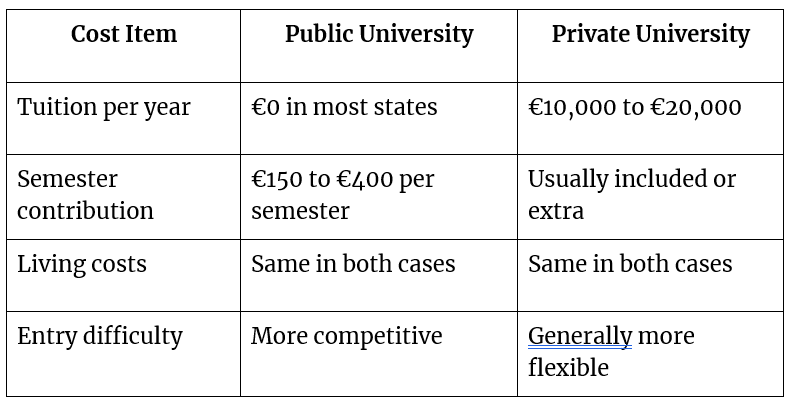
Most public universities in Germany charge no tuition fees, even for international students. You pay only a semester contribution, usually between €150 and €400, which often includes a transport ticket for your city or region.
There are two exceptions worth knowing. Public universities in Baden-Württemberg charge €1,500 per semester to non-EU students, and TUM in Munich now charges tuition to new non-EU students. Private universities set their own fees, often €10,000 to €20,000 a year. If you are unsure which route fits you, our comparison of public vs private universities in Germany breaks it down clearly.
To lower your costs even further, look into scholarships in Germany. The DAAD scholarship can cover living costs, travel, and insurance. Our financial aid and scholarships team can help you build a strong application.
Picking the right city is only half the job. The other half is paperwork, and Germany is strict about it. Since 2022, every Indian student must clear the APS (Academic Evaluation Centre) verification before applying for a Germany visa for students. APS checks that your Indian degree and marks are genuine, and delays here can push back your whole intake.
This is where we step in. Our team handles:
Many families searching for the best study abroad consultants in Hyderabad come to us because we do more than file forms. We plan the whole journey. Before you apply, please read our list of the documents required before filing a student visa and explore our full Study in Germany page for courses and intakes.
If you are ready to study abroad in Germany and want a plan that fits your budget, book a free consultation with WIKATI today.
Chemnitz is one of the cheapest cities in Germany for Indian students, with monthly costs of about €750 to €850 (roughly ₹82,500 to ₹93,500). Leipzig and Dresden are close behind and offer larger student communities.
Most Indian students need €850 to €1,300 a month, depending on the city. The blocked account releases €992 a month, which covers living costs in eastern cities like Leipzig and Dresden but usually falls short in Munich, Frankfurt, or Berlin.
The blocked account amount for 2026 is €11,904 a year, or €992 a month, and it’s expected to stay at this level for 2027 intakes. Confirm the figure with the German embassy before you deposit, because it’s linked to BAföG rates and can change.
Yes, most public universities charge no tuition. You pay a semester contribution of about €150 to €400. The exceptions are universities in Baden-Württemberg, which charge non-EU students €1,500 per semester, and TUM in Munich.
Yes. International students can work 140 full days or 280 half days a year. The minimum wage is set to rise to €14.60 per hour in 2027, which helps cover costs in pricier cities. Plan to support yourself without a job for the first few months, though.
© Copyright WIKATI Education Services LLC