
Ireland’s Graduate Scheme, officially called the Third Level Graduate Programme, gives eligible international graduates permission to stay on Stamp 1G after completing an approved Irish qualification. For Indian students, it can mean up to 12 months after an honors bachelor’s degree or up to 24 months after a master’s degree, giving you time to find graduate-level work and move toward an employment permit.
Among study abroad consultants Hyderabad students turn to, Wikati Education counsellors see Ireland as a strong option for students who want a European education, English-taught programs, and a clear post-study pathway. But the Ireland student visa journey does not end at graduation. You need to understand Stamp 1G, apply on time, and plan your job search with purpose.
Ireland is especially attractive for Indian students who want to study in an English-speaking European country. It has globally recognized universities, a growing technology and pharmaceutical sector, and a graduate route that can support the transition from classroom learning to professional employment. Still, the process needs planning. A good course choice, timely documentation, and a focused job-search approach can make a major difference to your outcome.
The Third Level Graduate Programme is Ireland’s post-study work permission for non-EEA graduates. It is commonly called the Graduate Route, Graduate Scheme, or Stamp 1G.
Once you receive your final award, you may apply to remain in Ireland to seek graduate-level employment. During Stamp 1G, you can work full time without first securing an employment permit. The aim is to help you find a role that supports an application for a Critical Skills Employment Permit, a General Employment Permit, or another qualifying immigration route.
This is not an open-ended work visa. It is a time-bound transition permission, so your job-search strategy should begin before your final semester ends.
The Graduate Scheme is designed for international students who successfully complete an eligible Irish qualification. However, obtaining an Ireland student visa is only the beginning of your journey. You must complete your course, maintain valid immigration permission, and meet the Graduate Scheme requirements to qualify for Stamp 1G.
Your Stamp 1G duration depends on the Irish National Framework of Qualifications (NFQ) level of your completed award.
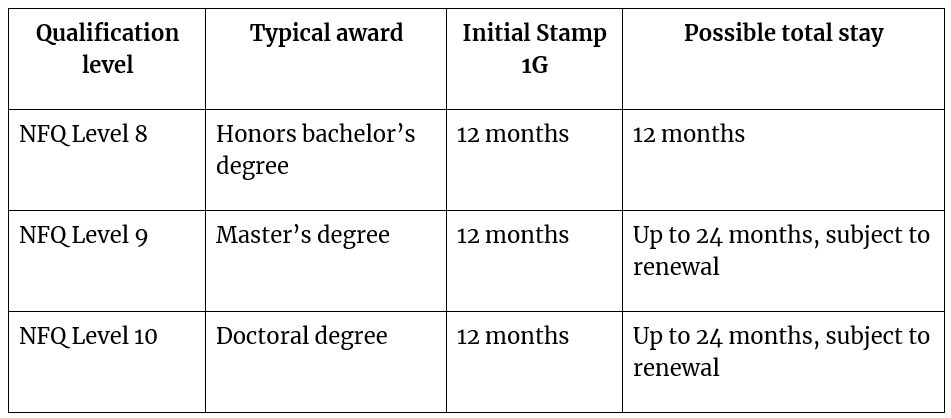
A Level 8 graduate receives 12 months on Stamp 1G. A Level 9 or Level 10 graduate receives 12 months initially and may receive a further 12 months if they show that they have taken appropriate steps to secure graduate-level employment, such as attending interviews or registering with graduate recruitment agencies.
The total time you can spend on the student pathway matters too. Level 8 graduates must not exceed seven years across relevant student permissions, while Level 9 or higher graduates must not exceed eight years.
For many Indian students, this makes a one-year master’s degree in Ireland especially appealing. You may complete an intensive program, receive a Level 9 award, and then have the opportunity to remain in Ireland for up to 24 months while seeking employment. However, you should not choose a course only because of the stay-back period. The program should match your academic background, career goals, and the type of roles you want to pursue after graduation. This guide on how to choose a course that aligns with your career goals explains how to make that decision.
You may be eligible for Ireland’s Graduate Scheme if you meet all of the following conditions:
A crucial point: you must complete the degree you enrolled in. If you leave a master’s program with only a postgraduate diploma, you generally will not qualify for Stamp 1G.
Before you apply for a student visa, confirm that your chosen institution and qualification meet Ireland’s eligibility requirements. Guidance from experienced overseas education consultants in Hyderabad can help you understand course recognition, admission requirements, and the documentation involved.
Do not wait for your graduation ceremony. Your application window opens when your institution formally notifies you that you have successfully completed the program and achieved the award.
You have six months from that notification to apply for Stamp 1G. At the time of application, you must still hold valid Stamp 2 permission and an up-to-date IRP card.
Wikati counsellors give students simple advice: treat the final-results notification as a deadline trigger. Start preparing your documents during your final term, then submit the application as soon as your official completion evidence is available.
Many students delay because they are waiting for their degree certificate, convocation, or final transcript. That can be risky. If your institution has issued an official completion letter or final-results confirmation, speak to its international office or registry team, and ask what evidence can be used for your Stamp 1G application. Acting early gives you more time to correct any document issue before your current permission expires.
Irish Immigration Service Delivery (ISD) lists the key documents for a Stamp 2 to Stamp 1G transition. Keep both digital and printed copies ready.
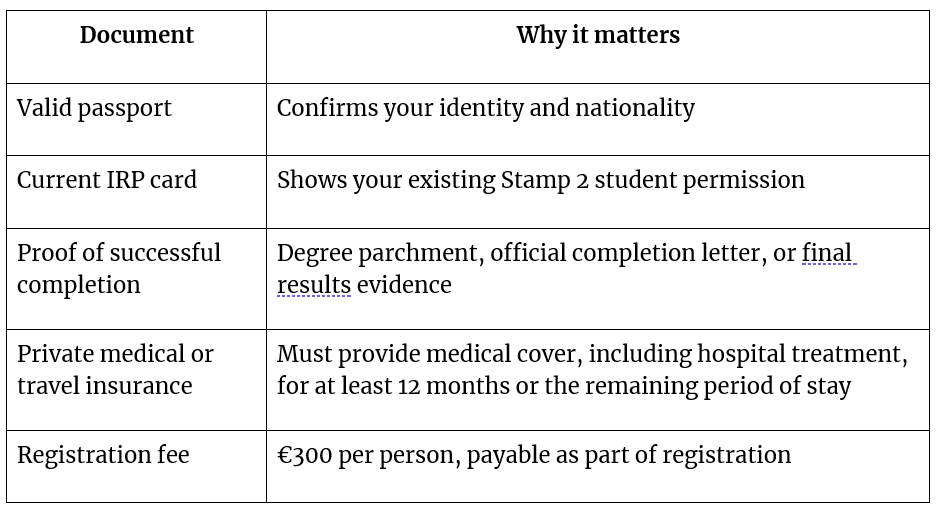
You should also retain evidence of your job-search activity, especially if you will need to renew Stamp 1G after a master’s or PhD. Interview invitations, applications, recruiter registrations, and employer communications can support your renewal case.
Before applying, check that your passport has enough validity, your IRP details are accurate, and your insurance policy clearly meets the required cover. Small documentation issues can create avoidable stress at a time when you should be focusing on interviews and job applications.
Indian students often compare Ireland with Canada and the UK before choosing a destination. Each system has a different structure, so the right choice depends on your course, career goal, and long-term immigration plan.
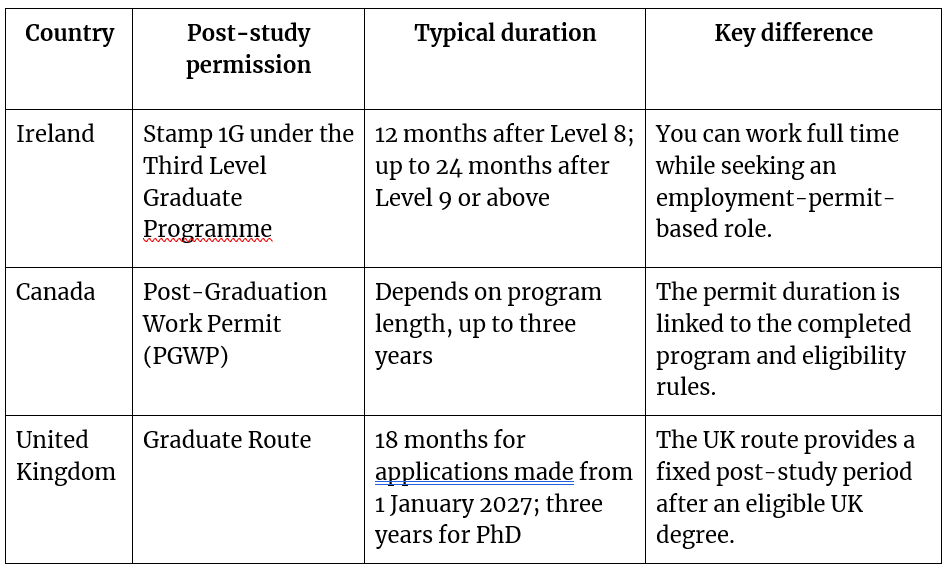
For more background on the UK route, read the Wikati guide on the UK post-study work visa, or explore our Study in UK page.
When comparing destinations, consider tuition fees, living costs, part-time work opportunities, industry demand, salary prospects, and visa rules. Choose a country whose job market aligns with your qualifications, skills, and long-term career goals. Our guide on what to consider before choosing a study destination can help with that comparison.
Ireland has a strong employer base in technology, life sciences, financial services, and shared services. Your employability will depend on your degree, internship experience, portfolio, communication skills, and the specific labor market demand at the time you graduate.
Dublin, Cork, Galway, and Limerick host global technology companies, software firms, cybersecurity teams, cloud providers, and data-led businesses. Indian graduates often explore roles in software development, data analysis, cybersecurity, cloud support, QA, product operations, and business analysis.
If you are studying computer science, data analytics, artificial intelligence, cybersecurity, cloud computing, or software engineering, build practical evidence of your skills. GitHub projects, certifications, hackathons, internships, and a clear portfolio can help you stand out in a competitive market.
Ireland is a major location for pharmaceutical manufacturing, biopharma, medical devices, and research-led companies. Graduates in pharmacy, biotechnology, biomedical science, chemistry, engineering, quality assurance, regulatory affairs, and supply chain may find opportunities across these sectors.
Indian graduates with science, pharmacy, engineering, or quality-focused backgrounds can explore Ireland’s life-sciences sector, including opportunities in research, manufacturing, validation, and regulatory affairs.
Dublin’s financial-services ecosystem includes banking, fintech, asset servicing, insurance, audit, consulting, and corporate operations. Graduates in finance, accounting, business analytics, economics, and management can target graduate programs, analyst roles, operations, risk, compliance, and client-service positions.
Business graduates should not rely only on generic job portals. Target graduate programs, use LinkedIn strategically, connect with alumni, attend employer events, and tailor every application to the role. A clear CV that shows projects, internships, tools, and measurable achievements can make a stronger impression than a long list of responsibilities.
Your degree alone will not secure a role. Build a targeted CV, practice interviews, attend university career fairs, connect with alumni, and apply consistently from the start of Stamp 1G.
At Wikati Education, our counsellors help students look beyond admission letters and think about the full study-to-career journey. With 1,600+ partner universities, the team supports course selection, applications, documentation, visa guidance, accommodation, and post-arrival planning.
Our Hyderabad counselling office is based in Jubilee Hills, and the team supports students who are comparing Ireland with the UK, Canada, Australia, the USA, Germany, and France. Experienced overseas education consultants in Hyderabad can help you assess whether a chosen course aligns with your academic background, budget, and career goals.
If you are still exploring your options, use the find the right university tool to discover programs that match your academic background and career goals. You can also talk to a Wikati counsellor for personalised guidance on your Ireland study plan.
Our counsellors often meet students who consider post-study work too late. Plan early by choosing career-focused courses, developing relevant skills, gaining practical experience, and understanding employment-permit options before graduation.
Ireland’s Graduate Scheme (Third Level Graduate Programme) allows eligible non-EEA graduates with a recognised Level 8 or higher qualification to stay in Ireland on Stamp 1G while seeking graduate-level jobs and applying for an employment permit.
Indian students with an NFQ Level 8 degree can usually get 12 months on Stamp 1G. Level 9 and 10 graduates may extend their stay for another 12 months, subject to eligibility and student-pathway limits.
Yes. Stamp 1G lets eligible graduates work full-time without a work permit, but they generally need one to stay after it expires.
Apply within six months of the official notification from your institution that you have successfully achieved your award. You must hold valid Stamp 2 permission and an up-to-date IRP card at the time of application.
No. Stamp 1G does not guarantee a job or permanent residence. It gives graduates time to find work and secure another qualifying immigration permission before expiry.
© Copyright WIKATI Education Services LLC