Top 5 Japanese Universities for Indian Students in 2027 Picked by a Foreign Study Consultant
Every year, Indian students ask a foreign study consultant the same question more often: “Can I really study in Japan without knowing Japanese?” The short answer is yes. Japan’s top universities now run full degree programs in English, and the fees are often lower than students expect.
This guide compares five universities that Wikati Education counsellors frequently suggest to Indian students planning to study abroad in 2027. For each one, it covers English-taught programs, fee range in INR, intake months, and scholarships. It also explains the visa process, living costs, and the funding options that make Japan attractive.
A quick note on numbers: yen has been converted at roughly ₹0.60 per ¥1. Exchange rates move, and some universities are revising fees for 2027, so always confirm the final figure on the official university page before you apply.
Why Japan Deserves a Spot on Your Shortlist
Most Indian families still think of the UK, USA, Canada, or Australia first. Japan rarely enters the conversation, which is why it is worth a closer look.
Here is what stands out:
Low tuition at national universities. Public universities in Japan charge far less than most Western institutions.
Safety and quality of life. Japan is one of the safest countries in the world for students.
Strong research culture. Engineering, robotics, environmental science, and materials science are world class.
Generous funding. The Japanese government actively funds international students, which makes it easier to study abroad with scholarship
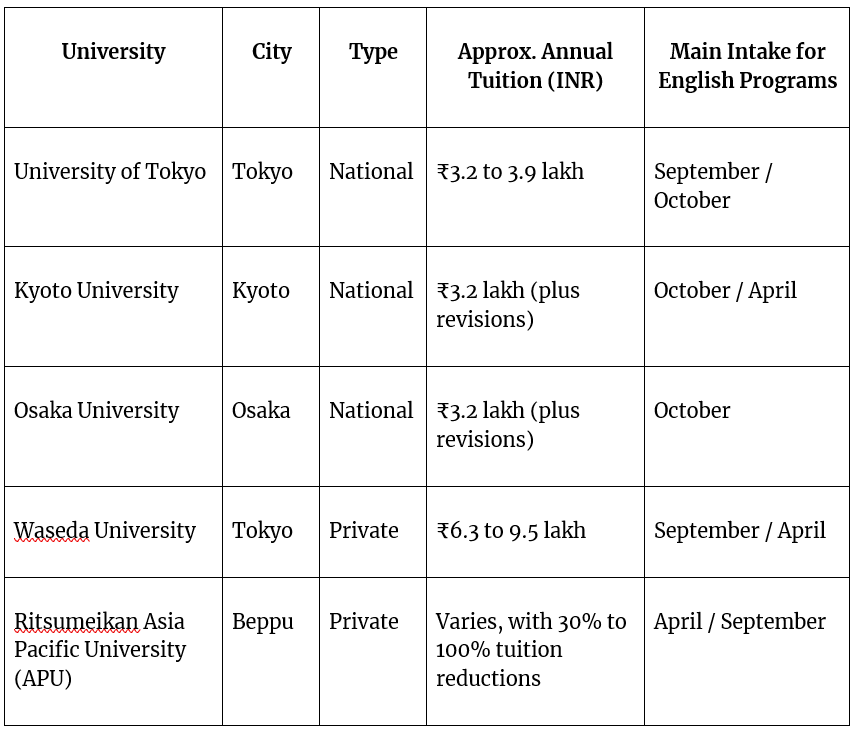
Quick Comparison: Top 5 Japanese Universities at a Glance
National universities also charge a one-time admission fee of about ¥282,000 (roughly ₹1.7 lakh). Waseda charges a ¥200,000 admission fee (about ₹1.2 lakh) in the first year.
Top 5 Japanese Universities for Indian Students in 2027
1. University of Tokyo
Japan’s most prestigious university is also more open to international students than many people assume.
English-taught programs: PEAK (Programs in English at Komaba) offers four-year undergraduate degrees in two areas: Japan in East Asia, and Environmental Sciences. At the graduate level, programs such as the Graduate Program on Global Society and several science and engineering tracks run fully in English.
Fee range in INR: Undergraduate tuition rose to ¥642,960 a year (about ₹3.9 lakh). Many graduate programs sit near ¥535,800 (about ₹3.2 lakh), plus the admission fee.
Intake months: PEAK starts in September/October. Graduate intakes vary by program, with October and April most common.
Scholarship options: The University of Tokyo Scholarship for PEAK covers tuition, admission, and a monthly allowance for a small number of students. MEXT and university fellowships are also available.
PEAK is highly competitive, with a small intake each year. A strong SAT or IB score and an excellent essay matter a lot here.
2. Kyoto University
Kyoto suits research-minded students who want a quieter, more traditional city.
English-taught programs: Kyoto offers many English-medium master’s and doctoral programs, especially in engineering, agriculture, energy science, and informatics.
Fee range in INR: Standard national tuition is ¥535,800 a year (about ₹3.2 lakh), plus the admission fee. Several national universities are raising fees for international students from 2027, so check the latest notice.
Intake months: Mostly October, with some April entries.
Scholarship options: MEXT (both Embassy and University Recommendation routes), tuition waivers, and private foundation scholarships.
3. Osaka University
Osaka blends top-tier science with one of Japan’s friendliest, most affordable big cities.
English-taught programs: Undergraduate options include the Chemistry-Biology Combined Major Program and the Human Sciences International Undergraduate Degree Program. Many graduate schools run English tracks in engineering and life sciences.
Fee range in INR: Around ¥535,800 a year (about ₹3.2 lakh) under the standard national rate, plus admission. Confirm 2027 revisions.
Intake months: October for most English undergraduate programs.
Scholarship options: MEXT, Osaka University scholarships for privately financed students, and JASSO support.
4. Waseda University
For students who want a private university in the heart of Tokyo with a large international community, Waseda is a strong choice.
English-taught programs: The School of International Liberal Studies (SILS) is the flagship. Political Science and Economics, Social Sciences, and Science and Engineering also offer English-based degrees, along with English graduate programs across many schools.
Fee range in INR: English-based undergraduate tuition runs ¥1,051,000 to ¥1,584,000 a year (about ₹6.3 to 9.5 lakh), plus the ¥200,000 admission fee.
Intake months: September for most international applicants, with April entry in some schools.
Scholarship options: Waseda’s partial tuition-waiver scholarship for privately financed international students, plus MEXT and private foundation awards.
Waseda hosts one of the largest international student populations in Japan, so settling in tends to feel easier.
5. Ritsumeikan Asia Pacific University (APU)
APU in Beppu was built for international students. Roughly half the students come from outside Japan.
English-taught programs: Every undergraduate degree is available fully in English, including Asia Pacific Studies, International Management, and Sustainability and Tourism. Graduate options include an AACSB-accredited MBA.
Fee range in INR: Tuition is higher than national universities before aid, but most students pay far less after scholarships. Check APU’s official 2027 fee page for the current figure.
Intake months: April and September.
Scholarship options: The APU Tuition Reduction Scholarship covers 30% to 100% of tuition, and APU reports that the vast majority of international students receive some scholarship support.
Students who also want to explore offbeat specializations beyond Japan can read the Wikati guide to niche programs abroad.
Language Requirements: Do You Need Japanese?
For English-taught programs, you do not need Japanese to get admitted. You do need to prove your English.
TOEFL iBT: Most programs look for 80 to 100 or above.
IELTS Academic: Usually 6.5 or higher, with some top programs asking for 7.0 or more.
Japanese: Not required for admission, but Wikati counsellors encourage students to learn basic Japanese. It helps with part-time work, internships, daily life, and job hunting after graduation.
Some programs, such as PEAK, include mandatory Japanese classes in the curriculum, so you will pick it up along the way.
Student Visa for Indian Students: Certificate of Eligibility Steps
The student visa for Indian students in Japan works differently from most countries. Everything starts with the Certificate of Eligibility (CoE), which your university applies for on your behalf.
Here is the step-by-step process:
Secure admission. Get your offer letter from a Japanese university.
Submit CoE documents. Send your passport copy, photos, academic records, and proof of funds to the university.
The university files the CoE. The university applies to Japan’s Immigration Services Agency. This usually takes one to three months.
Receive the CoE. The university sends it to you, often electronically.
Apply for the visa. Submit your application through the VFS Japan Visa Application Centre under the Embassy in New Delhi or the Consulates in Mumbai, Chennai, Kolkata, or Bengaluru. Processing typically takes 5 to 10 working days.
Travel and collect your residence card. You receive your Residence Card (Zairyu Card) on arrival at major airports.
The visa fee for Indian nationals is low, but confirm the current amount and VFS charges on the official Embassy of Japan in India website before you apply. It is best to start the full process six to nine months before your intake.
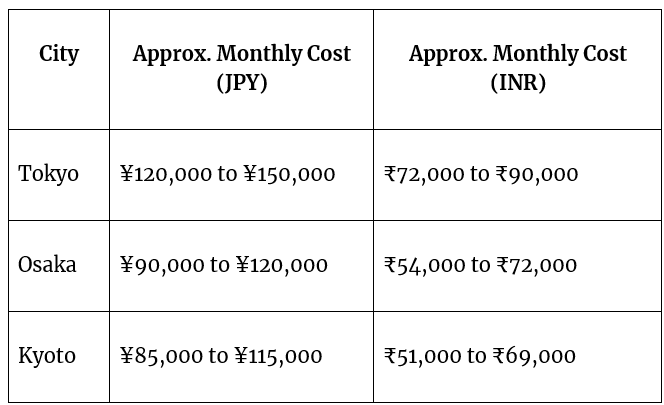
Living Costs in Tokyo, Osaka, and Kyoto
Tokyo
Highest rent in Japan; apartments near Waseda average ¥70,000 to ¥100,000 a month
Excellent transport, but daily commuting adds up
University dorms are the cheapest option
Osaka
Rent is noticeably lower than Tokyo
Food is cheap and famously good
Well connected to Kyoto and Kobe
Kyoto
Smaller, walkable, and student-friendly
Cycling saves a lot on transport
Rent rises near the city center and tourist areas
International students can usually work up to 28 hours a week during term with permission, which helps cover part of these costs.
Scholarship Pointers: How to Study Abroad With Scholarship Support in Japan
Japan is one of the best places to study abroad with scholarship funding. These are the options Wikati counsellors point students to first:
MEXT Scholarship (Japanese Government): Covers full tuition, round-trip airfare, and a monthly stipend. For the 2027 batch, the stipend is ¥117,000 for undergraduates and ¥143,000 to ¥145,000 for research students. Indian students usually apply through the Embassy of Japan in India, with applications typically opening around April to May. The window for the 2027 batch has closed, so if you are aiming for 2028 entry, start preparing now.
MEXT University Recommendation: Some universities nominate admitted students directly.
JASSO Honors Scholarship: A monthly support grant for privately financed students.
University-specific awards: Tuition waivers at Tokyo, Waseda, APU, and others.
How WIKATI Education Helps Students Plan for Japan
Japan is very doable, but there are many moving parts: test scores, applications, CoE paperwork, and scholarship deadlines that rarely line up neatly.
This is where an experienced foreign study consultant can make a real difference. WIKATI Education counsellors have guided Indian students through international admissions for over 13 years. Families in Hyderabad can meet the team at the Jubilee Hills office, and students across India are supported online. Choosing the right advisor matters, and this guide on how to choose the best study abroad consultants in India explains what to look for.
Here is how Wikati supports a Japan plan:
Test preparation.IELTS guidance helps students reach the band score their program needs, with TOEFL and GRE guidance for graduate applicants.
University shortlisting. The university finder tool helps match a student’s profile with the right programs.
Visa and CoE support. Wikati’s visa application assistance helps students prepare every document the university needs to file the CoE.
Students looking for a reliable consultancy for abroad studies in Hyderabad can book a free consultation to map out their Japan journey.
Conclusion
Japan offers something rare: elite degrees, English-taught programs, low public tuition, and serious scholarship funding. Whether you choose Tokyo, Kyoto, Osaka, Waseda, or APU, the key is to start early and plan each step.
Can Indian students study in Japan in English without knowing Japanese? Yes. Universities such as the University of Tokyo, Waseda, Osaka, Kyoto, and APU offer full degree programs in English. You need IELTS or TOEFL scores instead of Japanese. Learning basic Japanese is still helpful for daily life and part-time jobs.
How much does it cost to study in Japan for Indian students? National universities charge about ¥535,800 to ¥642,960 a year, roughly ₹3.2 to 3.9 lakh, plus a one-time admission fee. Private universities like Waseda cost about ₹6.3 to 9.5 lakh a year. Living costs range from about ₹51,000 to ₹90,000 a month depending on the city.
What is the Certificate of Eligibility for a Japan student visa? The Certificate of Eligibility (CoE) is a document issued by Japan’s Immigration Services Agency confirming you qualify for a student visa. Your university applies for it after you are admitted. Once you receive it, you apply for the visa through the Japanese Embassy or a Consulate in India.
Is the MEXT scholarship fully funded for Indian students? Yes. MEXT covers full tuition, round-trip airfare, and a monthly stipend. For the 2027 batch, the stipend is ¥117,000 for undergraduates and ¥143,000 to ¥145,000 for research students. Indian applicants usually apply through the Embassy of Japan in India.
Can international students work part-time while studying in Japan? Yes. With permission from immigration, international students can usually work up to 28 hours a week during the term and longer during official holidays. Many students work in retail, restaurants, or as English tutors.