
Most families plan for tuition and then get blindsided by everything else: the visa, the health surcharge, the test fees, the deposit, and the flight. This guide puts every cost on the table before you pay a single rupee.
Quick answer: For 2027, plan on roughly ₹10 to ₹16 lakh a year in Germany, ₹20 to ₹35 lakh a year in Canada, ₹28 to ₹45 lakh a year in Australia, ₹30 to ₹55 lakh a year in the USA, and ₹28 to ₹45 lakh for a one-year master’s in the UK. These all-in figures cover tuition, living, insurance, the student visa for Indian students, and flights.
At WIKATI, we have sat across the table from thousands of families who asked the same question in slightly different words: “What will this actually cost us?” The honest answer is that tuition is only part of the bill. In this guide, we walk you through every line item, country by country, and show you where you can save.
Last updated: November 12, 2026. Every government fee below is named with its official source. Exchange rates used: £1 = ₹120, $1 = ₹90, AUD 1 = ₹59, CAD 1 = ₹65, €1 = ₹105. Rates move daily, so please recheck before you budget.
Here is the big picture first. Think of this table as your starting point, then read the country sections for the detail behind each number.
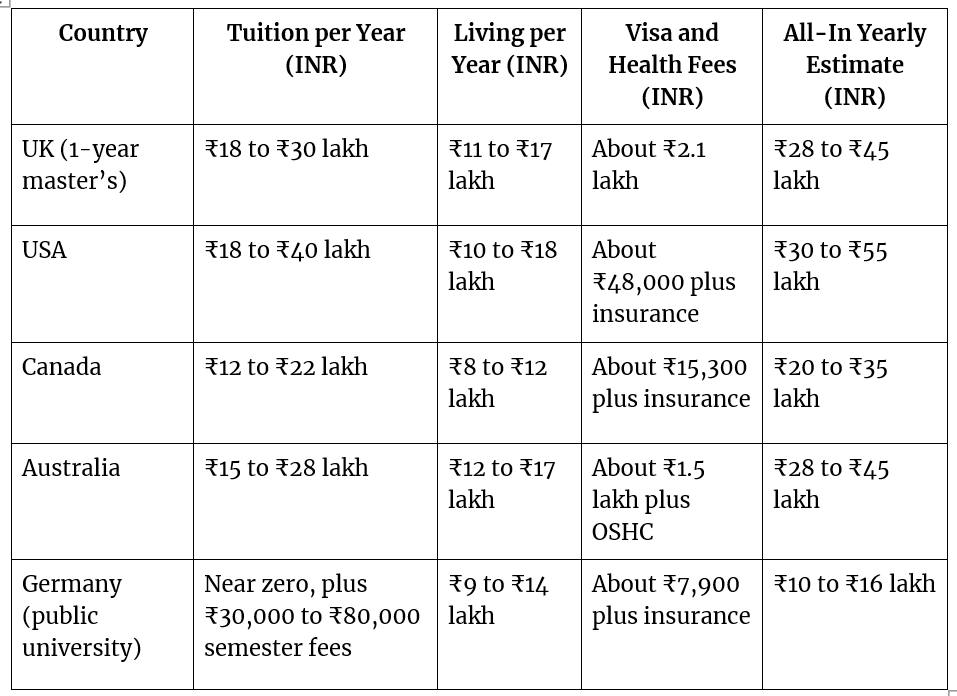
These are our working ranges for a single student on a typical master’s program. Your actual figure depends on the university, the city, and your lifestyle. For a deeper look at the costs most families forget, read our study abroad budget guide.
The UK is popular because most master’s programs finish in one year, which cuts your living costs in half compared to a two-year degree.
The US offers the widest choice of programs and strong STEM career paths, but it is usually the priciest destination over a full degree.
Canada balances cost and quality well, and its colleges offer shorter, career-focused programs.
Australia offers generous work rights and a strong lifestyle, but its visa fee is now among the highest in the world.
Germany is the clear budget winner, as most public universities charge no tuition for international students.
Our travel and forex team can help you book flights and manage currency at the best available rates.
These costs hit months before you board a plane, and they add up faster than most students expect. Here is what to set aside.
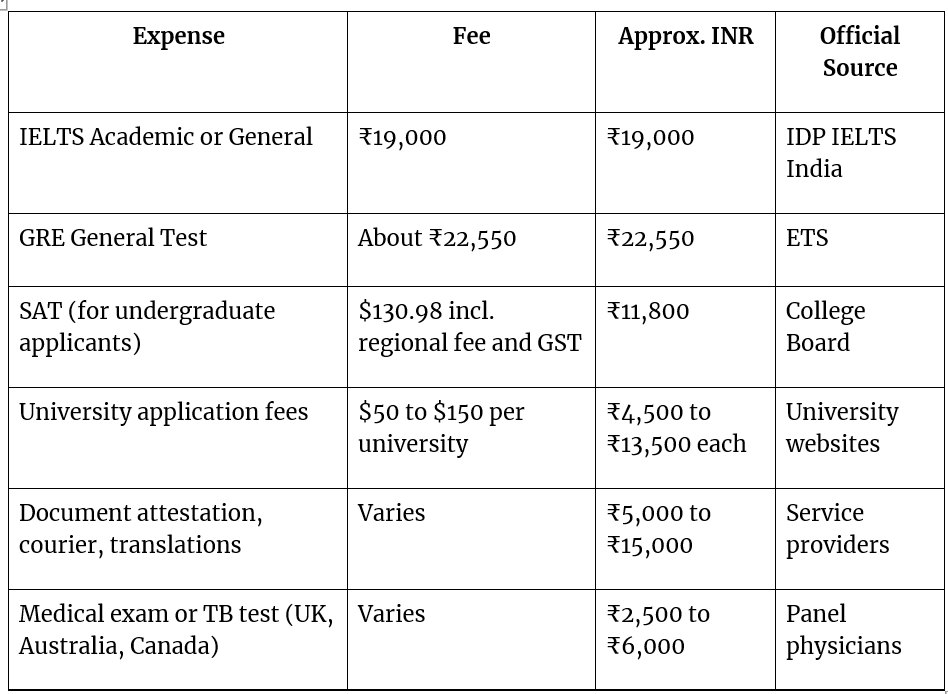
The IELTS examination fee went up from ₹18,000 to ₹19,000 on April 1, 2026, for both Academic and General Training. The UKVI version costs a little more. Since IELTS exam fees in India are the same in every city, there is no benefit in traveling to another center. For registration steps and current charges, see our guide to the IELTS exam fee increase in 2026.
If you are applying to master’s programs in the US or to some STEM programs elsewhere, budget for the GRE. Current GRE fees in India sit at about ₹22,550 for the General Test, according to ETS. Rescheduling and extra score reports cost extra, so try to book a date you can stick with. We break down the GRE exam fee, the syllabus, and a study timeline in our post on the GRE test fee and syllabus.
One tip we give every student: the GRE test fee is small compared to what a strong score can save you in scholarships.
Most students apply to five to eight universities. At an average of ₹9,000 each, that is ₹45,000 to ₹72,000 before you hold a single offer. Many universities waive this fee for early applicants or during open days, so it is worth asking. Our university application processing service helps you target the right shortlist so you don’t pay for applications you don’t need.
The numbers above are not fixed. With the right plan, many of our students cut their total bill by 20 to 50 percent.
If you want to study abroad with scholarship support, start early. Most merit awards close three to six months before the intake. Options include university merit awards, Chevening and Commonwealth in the UK, Fulbright-Nehru in the US, DAAD in Germany, and the Australia Awards. Explore what fits your profile on our scholarships and financial aid page.
Germany is the best-known tuition-free option, but it is not the only low-cost route. Public universities in France also keep fees relatively low for international students, and many programs there are taught in English and suit Indian graduates well.
Part-time work will not pay your tuition, but it can cover a large share of your rent and food. Here is what each country allows during term time:
Remember that you cannot use expected job income to meet visa fund requirements. You still need to show the full amount upfront.
Rent is the biggest variable in your budget. Studying in Manchester instead of London, or Leipzig instead of Munich, can save you several lakh a year without changing the quality of your degree. Our university finder lets you compare options by city.
Even with scholarships and savings, most families need some form of financing. This is one of the areas where we help the most.
Through our education loan assistance, we connect students with lenders offering loans of up to ₹85 lakh with no collateral, subject to eligibility. Here is how we support you:
A sanctioned loan often makes the visa stage much smoother, because your financial documents are clean and consistent from day one. Our documentation guidance team makes sure everything lines up.
Build your budget in three layers: pre-departure costs, first-year costs, and the rest of the course. Add a 10 to 15 percent buffer for currency swings. Then work on bringing that total down through scholarships, city choice, and smart financing. A clear plan matters as much as a strong application, and it is often what makes the student visa for Indian students stage stress-free.
If you would like a personal cost estimate for your shortlisted universities, our counsellors are happy to sit down with you and your family.
Germany is usually the cheapest. Public universities charge almost no tuition, so your total cost is mainly living expenses of about ₹10 to ₹16 lakh a year. You must show a blocked account of around €11,904 for your visa.
It depends on the country. Australia requires AUD 29,710 a year for living costs plus tuition and travel. Canada requires CAD 23,448 plus tuition and travel. Germany requires a blocked account of about €11,904. The UK and USA ask you to show tuition plus living costs for the period stated by the university or embassy.
The UK student visa fee is £558, or about ₹67,000, as of April 2026. You also pay the Immigration Health Surcharge of £776 per year of your visa. For a one-year master’s, the total is usually around £1,722, or about ₹2.1 lakh.
In some cases, yes. You can choose tuition-free public universities in Germany, or win a fully funded scholarship such as Chevening, Fulbright-Nehru, or DAAD. You will still need to cover living costs unless the scholarship includes a stipend.
The IELTS fee in India is ₹19,000 for both Academic and General Training, effective April 1, 2026. The GRE General Test costs about ₹22,550, as listed by ETS. Fees can change, so confirm on the official websites before you register.
© Copyright WIKATI Education Services LLC