
A visa stamp can feel like the last mountain before Germany becomes real.
One rejected blocked account statement. One missed VFS slot. One anxious scroll through embassy updates at 1 a.m. Sounds familiar?
If you are planning to study abroad in Germany for the 2027 intake, the process is simpler than the internet makes it look. This guide breaks down the German visa for students step by step: costs, timeline, documents, and the small details that trip up otherwise strong applications.
No jargon. No guesswork. Just what Indian applicants actually need to know before booking that VFS appointment.
Something shifted in global education over the last year. India is now the single largest source of international students in Germany, overtaking China for the first time on record. Germany's own statistics office, Destatis, counted 59,419 Indian students enrolled in the 2024/25 winter semester, a jump of 20 percent in a single year.
For families weighing Germany against other countries, the maths is simple: lower fees, strong post-study work rights, and rising demand for skilled graduates. That is exactly why interest in the German visa for students has surged this year.
Before you touch a single form, understand the visa category you actually need. Germany offers a few routes, and picking the wrong one wastes weeks.
There are two main routes. The German Student Applicant Visa suits candidates still awaiting admission. Most Indian students with a confirmed offer apply directly for the long-stay National Visa, Type D, which later converts into a residence permit after arrival.
Choosing the wrong category delays your master's study in Germany by weeks. Confirm your status against your university admission letter before you book anything.
The Academic Evaluation Centre, or APS, verifies your academic documents before the embassy accepts your visa file. Nearly every Indian bachelor's and master's applicant needs one; PhD and postdoc candidates are usually exempt.
Skipping this step is the single biggest reason German visa for students applications stall at the first hurdle. Apply for APS certification the moment your offer letter arrives, not after.
Requirements have stayed fairly consistent heading into 2027, though blocked account figures shift with each intake cycle. Here is what every applicant should keep ready.
The blocked account, or Sperrkonto, remains the backbone of financial proof for any German visa for students' application. For the 2026 intake cycle, the required deposit is €11,904 a year, released at roughly €992 a month.
Expect this figure to hold steady or rise slightly for 2027, since it tracks Germany's official living-cost calculation. Full scholarship holders often skip this step, which is one more reason scholarships in Germany are worth chasing early.
Germany has no single national IELTS rule for visas. What matters is your university's own language requirement. English-taught master's programmes typically ask for an IELTS score of 6.5 to 7.0 overall.
The embassy accepts your admission letter as proof once that box is ticked. Applicants pursuing master's studies in Germany in German-taught programmes need a recognised German-language certificate instead.
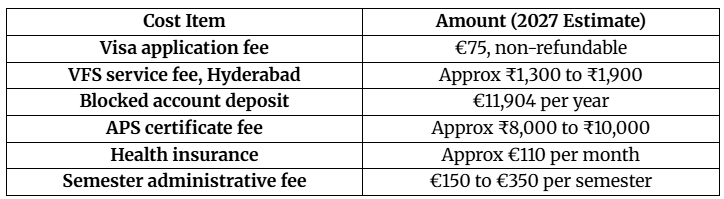
Costs are refreshingly transparent compared to some Western destinations. Here is a realistic 2027 budget snapshot for the German visa for students process.
Patience matters here. The German visa for students process typically takes 6 to 12 weeks from a complete file submission, though peak season can stretch this further.
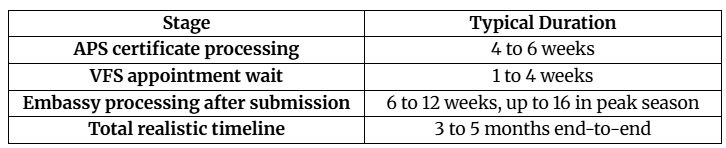
Start your German visa for students file the moment your admission letter arrives. Waiting until two months before departure is the most common, and most avoidable, mistake.
Hyderabad applicants submit German visa files through the VFS Global centre in Banjara Hills. Slots fill quickly during peak intake months, April through August, so reserve yours as soon as your APS certificate and offer letter are confirmed.
Hyderabad's queue moves faster outside peak months. Booking early remains the single best trick for a smooth German visa for students experience.
Scholarships in Germany can shrink your blocked account burden significantly, sometimes to zero. The DAAD Study Scholarship offers roughly €992 a month for master's students, alongside tuition support at public universities.
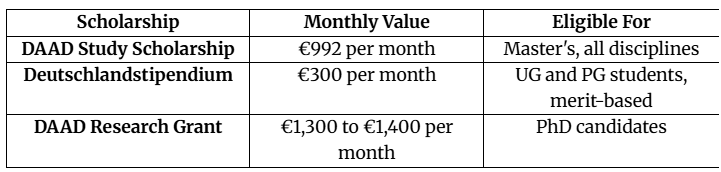
Deadlines for most scholarships in Germany fall between September and November, roughly a year before intake. Apply well before your visa file, not alongside it.
Once your German visa for students is approved, work rights kick in fast. International students can now work 140 full days, or 280 half-days, a year, up from 120 previously. During semester breaks, full-time work is allowed without touching that annual cap.
This flexibility makes a master's study in Germany financially manageable even beyond the blocked account cushion.
Reading through blocked account math, APS timelines, and VFS slots back to back is exhausting, and that is exactly where most applications lose momentum.
At WIKATI Education, we have walked Indian students through this exact process for over 13 years. Our British Council and PIER-certified counsellors handle APS documentation, blocked account setup, and VFS scheduling personally, so nothing slips through the cracks.
We have placed over 15,000 students across six countries, holding a 98.6% visa success rate along the way. Our vision has always been simple: to make studying abroad in Germany, or anywhere else, feel achievable rather than overwhelming.
We also arrange education loans up to ₹85 lakhs with no collateral, so funding never becomes the reason a strong application stalls.
Blocked accounts, APS certificates, VFS queues: none of it needs to feel impossible. The German visa for students process rewards early movers and clean paperwork; nothing more mysterious than that.
2027 intake seats are filling fast, and Germany's popularity among Indian students shows no sign of slowing.
Talk to WIKATI Education today and fast-track your German visa for students journey.
Secure your university offer, get APS certified, open a blocked account, then book your VFS Global appointment. Submit documents, pay the €75 fee, and await embassy processing.
Processing typically takes 6 to 12 weeks after a complete file submission. Add APS and VFS appointment waits, and total timelines often stretch to 3 to 5 months.
Indian applicants must deposit €11,904 for 2026 intakes into a blocked account, releasing about €992 monthly. This proves you can cover a year's living costs.
Not universally. English-taught master's programmes usually require IELTS 6.5 to 7.0, and your admission letter satisfies the embassy once university requirements are met.
Yes. International students can work 140 full days, or 280 half-days, yearly, plus full-time hours during semester breaks, without needing a separate work permit.
Almost always, unless you're pursuing a PhD, postdoc, or scholarship-funded programme. APS verifies your academic documents before the embassy processes your visa file.
Competitive, yes, but achievable. DAAD and Deutschlandstipendium reward strong academics and clear motivation letters. Apply a year ahead, since deadlines fall well before visa season.
Create a CSP portal profile, upload documents, and then book online at the Banjara Hills VFS centre. Book 6 to 8 weeks ahead, especially during peak April to August intake.
© Copyright WIKATI Education Services LLC