
You got the offer letter. The visa is approved. Now comes the question every Indian student asks within a week of landing in Melbourne or Sydney: how many hours can you work, and what happens if you get it wrong?
If you plan to study in Australia, a part-time job will likely be part of your plan. It helps with rent, groceries, and the occasional weekend trip. But your visa comes with clear work conditions, and the most useful visa information Australia offers students is this: know those rules before your first shift, not after.
We meet many students in Hyderabad who know their course, their city, and their intake but have only a vague idea of their work limits. This guide fixes that. It covers seven rules, in plain language, so you can earn well and keep your visa safe.
Quick Answer: How Many Hours Can You Work on an Australia Student Visa?
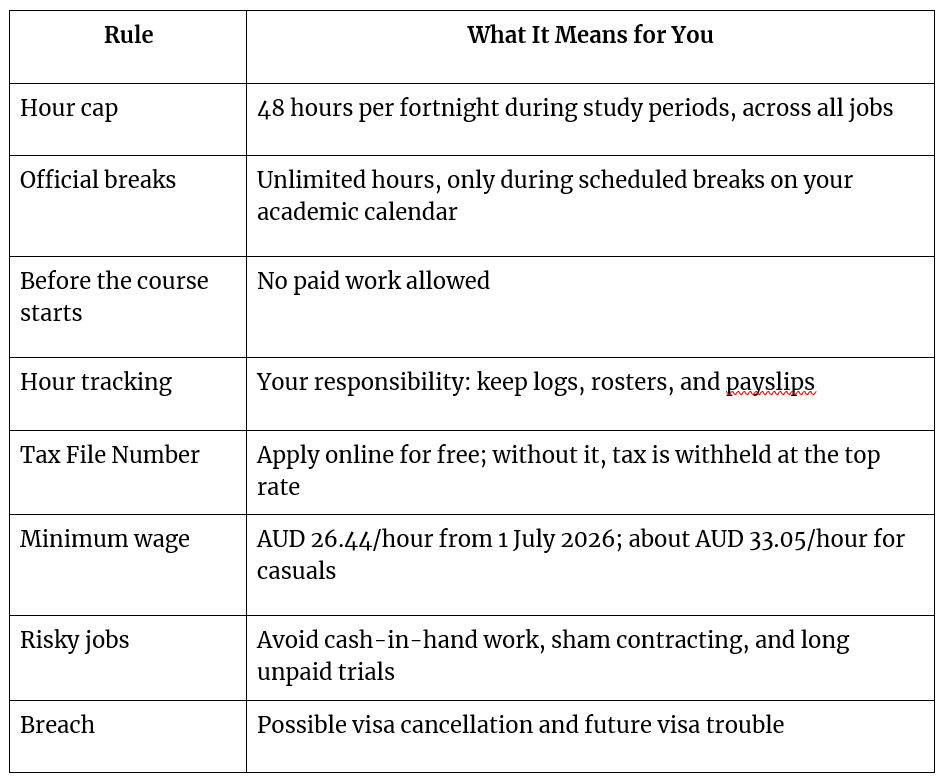
On an Australia student visa (subclass 500), you can work up to 48 hours per fortnight while your course is in session. During official course breaks, such as semester holidays, there is no hour limit. You cannot start paid work before your course begins. This 48-hour cap is still the rule as of November 2026.
You may have read that the limit is rising to 60 hours. That figure came from an election proposal. It is not law, so plan around 48.
These rules come from visa condition 8105, which applies to most student visa holders, along with Australian workplace and tax law. Here they are, one by one.
A fortnight is any 14-day period that starts on a Monday. The limit is not “24 hours a week.” You can work 30 hours one week and 18 the next and still be compliant.
What catches students out is the rolling nature of the count. Every Monday starts a new fortnight. So the week you just finished pairs with the week before it, and also with the week after it. Both pairs must stay at or under 48.
The cap also covers every job you hold. If you work 28 hours at a café and 22 hours on a delivery app in the same fortnight, that is 50 hours. That is a breach, even though neither employer did anything wrong.
One exception is worth knowing. Students in a master’s by research or a PhD can work unlimited hours once their course has started.
Unlimited hours apply only during your provider’s official breaks. That means the scheduled gaps between semesters or terms listed in your academic calendar.
A few things do not count as breaks:
Download your academic calendar on day one and save the break dates. If you are unsure, ask your international student office in writing. Once a break ends, you go straight back to 48 hours per fortnight.
Your employer does not track your visa limit. You do. Many students who breach their conditions do it by accident, often by picking up extra shifts during a busy month.
A simple tracking habit keeps you safe:
Home Affairs can compare your visa records with tax and payroll data. Your own records are your best defense if questions ever come up.
A Tax File Number (TFN) is your personal tax ID in Australia. You can apply online through the Australian Taxation Office once you arrive and your visa allows you to work. It is free.
Without a TFN, your employer must withhold tax at the highest rate. You can get some of it back later, but your weekly take-home pay will be smaller in the meantime.
Two more points matter here. Your employer must also pay superannuation, which is a retirement contribution set at 12% of your ordinary earnings. And at the end of each financial year (30 June), you lodge a tax return. Many students get a refund, so do not skip it.
International students have the same workplace rights as Australian workers. That includes minimum pay.
From 1 July 2026, the National Minimum Wage is AUD 26.44 per hour for adults. Casual workers on that rate get a 25% loading, which brings it to about AUD 33.05 per hour. Many jobs are covered by an industry award, and award rates can be higher, especially on weekends, nights, and public holidays.
If someone offers you AUD 15 an hour “because you are a student,” that is illegal. You can check your correct rate with the Fair Work Ombudsman’s free pay calculator.
Some jobs look like easy money but create real problems for your visa and your wallet. Steer clear of these:
Unpaid work that would normally be paid can also count toward your 48 hours.
This is the rule that matters most. Working more than your permitted hours breaches condition 8105. The Department of Home Affairs can then cancel your Australia student visa.
A cancellation can mean:
Even a single bad fortnight is a risk you do not need. No extra shift is worth your degree.
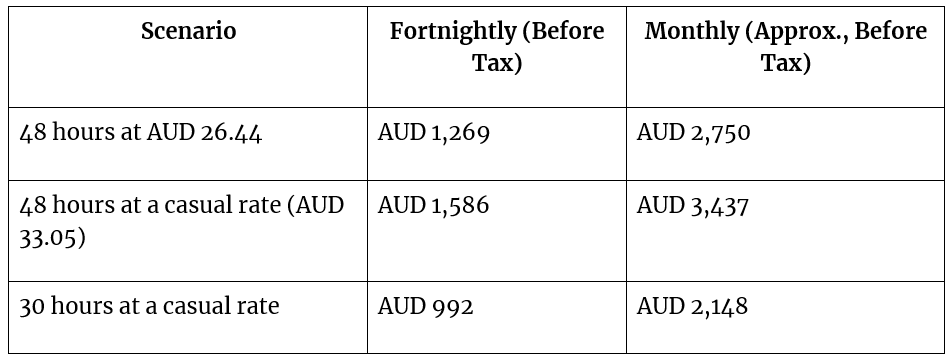
Part-time work helps a lot, but it will not pay for everything. Here is a realistic picture based on the 2026 minimum rates.
Now compare that with typical student spending:
The takeaway is simple. A part-time job can cover a big share of your weekly living costs. It should not be your plan for tuition. Meeting the Australia study visa requirements still means showing enough funds before you go, and part-time income does not replace that. Our guide to the Australia student visa process and fees covers the financial evidence you will need. If you need help building those funds, our overseas education loan assistance can support you.
Your student job is not only about money. It is also your first step into the Australian workforce.
After you graduate, you may be eligible for the Temporary Graduate visa (subclass 485). Under the Post-Higher Education Work stream, bachelor’s and coursework master’s graduates can usually stay up to two years, and research graduates can stay longer. Most applicants must be 35 or under.
Here is why your student years matter:
Every shift builds your profile, not just your bank balance.
Knowing the rules on paper is one thing. Living by them while juggling classes, rent, and a new city is another. That is why we built a visa-compliance briefing into our pre-departure support at WIKATI Education.
Families who search for study abroad consultants Hyderabad often ask us what happens after the visa lands. So we sit down with every Australia-bound student before they fly. The session focuses only on what keeps your visa safe once you land:
Parents often join this session too. We also help with travel and forex and accommodation before you leave.
If you are still at the start of your journey and wondering how to apply for an Australian student visa, we can walk you through that as well. Our step-by-step guide on the steps to secure an Australian student visa is a good place to begin. It also helps to read about the latest Australia visa fee changes before you budget and to explore universities and cities on our Study in Australia page.
A strong Australia visa application gets you in. Smart work habits keep you there. Book a free consultation with WIKATI Education for clear visa information Australia students can rely on, and let us help you plan both.
Student visa holders can work up to 48 hours per fortnight while their course is in session and unlimited hours during official course breaks. Master’s by Research and PhD students can work unlimited hours once their course starts. Always confirm the current limit on the Department of Home Affairs website before you plan your roster.
No. As of November 2026, the legal limit is still 48 hours per fortnight. The 60-hour figure came from an election proposal and has not become law. Until Home Affairs officially changes visa condition 8105, students should keep their hours at or below 48 per fortnight.
Yes. During official breaks listed in your provider’s academic calendar, there is no limit on your work hours. Study weeks, exam periods, and weeks with no classes do not count as breaks. Once the scheduled break ends, the 48-hour fortnightly cap applies again from that point.
From 1 July 2026, the National Minimum Wage is AUD 26.44 per hour for adults. Casual workers on that rate receive a 25% loading, about AUD 33.05 per hour. Many industry awards pay more, especially on weekends. International students have the same pay rights as Australian workers.
Working beyond your limit breaches visa condition 8105. The Department of Home Affairs can cancel your visa, which may mean leaving Australia and losing your course place. A cancellation can also make future visas harder to get, including the Temporary Graduate visa (subclass 485).
© Copyright WIKATI Education Services LLC