
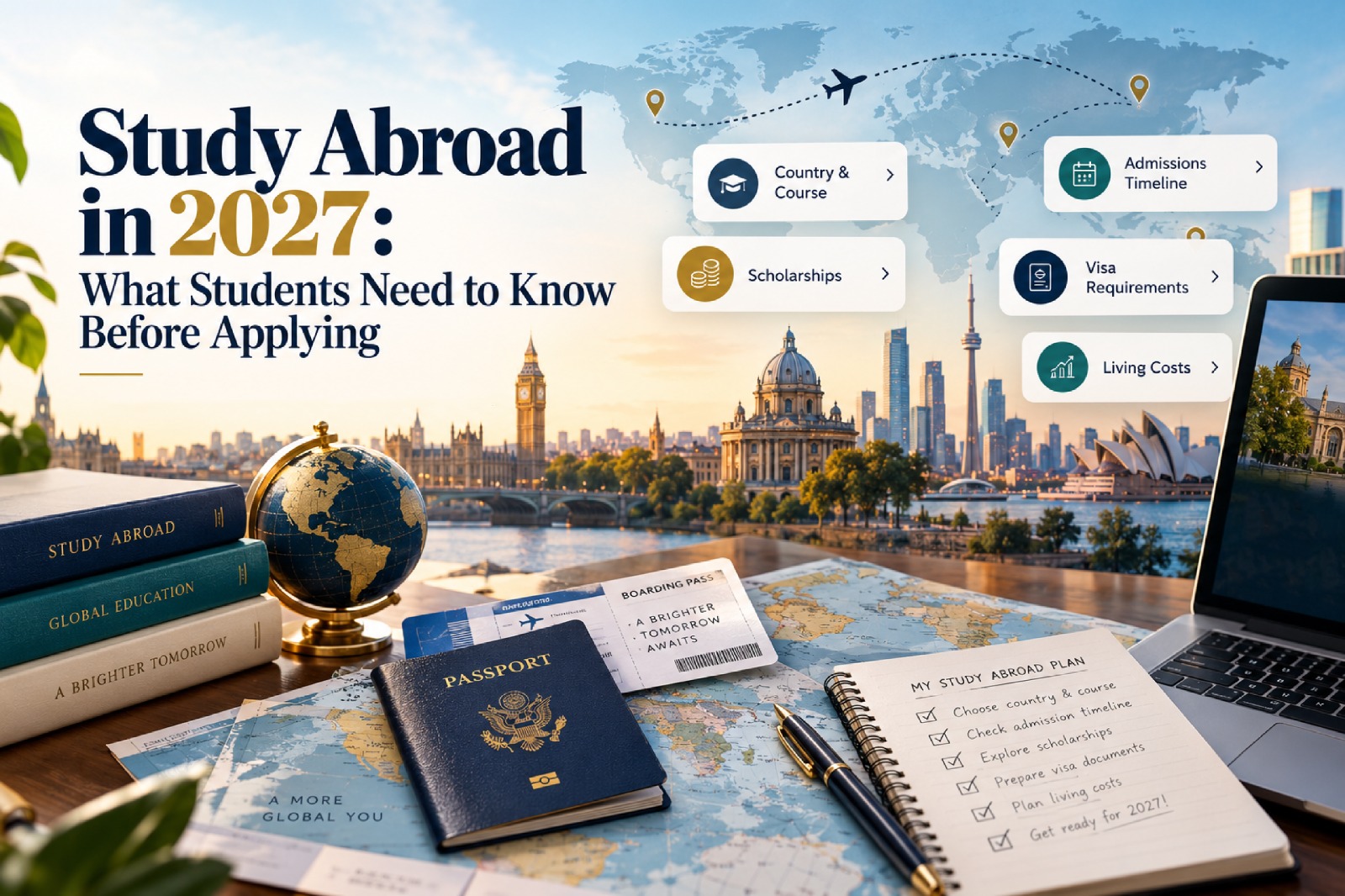
If you plan to start your degree abroad in 2027, the next few months decide how smooth the rest of the process feels. Students who begin early get better choices on universities, scholarships and accommodation. Students who start late end up rushing documents, paying for last-minute fixes, and settling for whatever intake is still open.
Rules also keep shifting. Visa requirements, funding checks, work rights and fee structures have all been updated in major study destinations over the last two years, and more changes may follow. So the plan that worked for a cousin who left in 2023 may not work for you.
This guide walks you through what to sort out before you send a single application, and how to apply for student visa approval without avoidable delays. At Wikati, we have guided 15,000+ students through this process from our Hyderabad office, and this is the plan we follow with them.
Everything else depends on three choices: country, course and intake.
Country. Compare destinations on total cost, post-study work options, course length, and how well the country matches your career plan. The UK offers one-year master's degrees. Germany has low or no tuition at most public universities. The USA gives wide course choice and long research and work options for STEM graduates. Australia and Canada combine work-friendly policies with large student communities. France and Ireland are growing choices for business and technology.
Course. Pick the subject first and the university second. Read the module list, check career outcomes, and make sure the course fits what you want to do after graduation. A simple scoring sheet helps: rate each shortlisted university on course fit, cost, career outcomes and entry requirements. If you are leaning towards business or management, our comparison of the top study abroad countries for business is a useful starting point.
Intake. Most students aim for autumn 2027, but several countries also run January, February or mid-year intakes. If your documents or scores aren't ready, a later start can give you a stronger application. Read our comparison of the January and September intakes before you decide.
Work backwards from your intake date. Here is a realistic plan for a September 2027 start.
12 to 10 months before (September to November 2026)
9 to 7 months before (December 2026 to February 2027)
6 to 4 months before (March to May 2027)
4 to 2 months before (May to July 2027)
2 to 1 months before (June to August 2027)
Many countries let you apply for a visa only after you hold an offer or confirmation letter, so offers drive your visa timeline. Visa processing can take a few weeks, and busy months stretch that. Don't leave it for the last fortnight. Wikati counsellors build this timeline with every student and track test dates, document deadlines and visa slots on your behalf.
English tests are the most common requirement. IELTS and TOEFL are widely accepted, and some universities accept the Duolingo English Test or Pearson test. Check which test your university and your visa route accept, because the two can differ. In the UK, for example, some visa routes need an approved secure English test.
For some courses and countries, you also need a GRE, GMAT or SAT. Book your slot early, since popular dates in Hyderabad fill up. If you need to retake a test, leave a gap of at least a month or two before your application deadline.
Useful guides:
Most delays happen because a document is missing, expired, or doesn't match another one. Start a folder today.
Names, dates and spellings must match across every document. A mismatch between your passport and your degree certificate can hold up a visa file for weeks. Fix errors early. Wikati's documentation guidance team checks every file for mismatched names, dates and missing papers before it reaches a university or an embassy.
If your final-year marks are still to come, ask your university when provisional results will be ready. If your work experience is thin, look for an internship, a live project or volunteering that backs up your chosen course.
A gap year, a backlog or a switch in subject isn't a barrier by itself. It needs a clear, honest explanation and a document trail that supports it.
Visa officers want to see that you can pay for tuition and living costs without breaking the rules on work. Each country sets its own funds requirement, and the numbers change. Always check the latest figure on the official government page.
Then look at how you will fund it: family savings, scholarships, an education loan, or a mix. Apply for scholarships alongside your university applications, not after. Explore the options on our financial aid and scholarships page.
Your application is more than marks. Admissions teams read your statement of purpose, recommendation letters, CV and any portfolio to judge fit.
Keep your statement specific. Say why this course, why this university and why now. Our guide to building a strong SOP and LOR shows how to structure each document.
Some universities issue offers with conditions, such as a final transcript or an English score. Learn the difference between conditional and unconditional offers so you know what to do next.
The exact steps vary by country, but the pattern is similar.
Student visa guidance varies a lot by country, so read our student visa guide for Indian students for a detailed walkthrough. Country-specific pages on Australia and Germany cover 2027 requirements, fees and timelines.
How Wikati helps. Our visa team prepares your file, checks it against the latest embassy rules and coaches you for the interview. Wikati's 98.6% visa success rate comes from this kind of file-by-file checking, not from shortcuts.
Once your visa is approved, sort the practical side. Book accommodation early, since university halls fill fast and private rentals near campus can be costly in peak months. Buy health insurance that meets your destination's rules. Share your arrival details with the university so you can join orientation and pick-up programmes. Wikati's accommodation, travel and forex assistance covers these steps in one place.
Not every country interviews every applicant, but when it happens, preparation helps. Officers usually check three things: that you are a genuine student, that you can afford the course, and that you have clear plans.
Practise answers to questions such as:
Speak plainly, answer what is asked, and carry original documents. Our guide on what visa officers check explains the checks in more detail.
Study destinations have updated rules on fees, funds, work hours, dependants and post-study work. Your plan should allow for more changes before 2027. Review the official government pages again before you submit your application and again before you pay any fee. Our update on the latest visa rule changes is a good place to see what has already moved.
Wikati is a study abroad consultancy in Hyderabad, and visa work is where our track record is strongest. We have placed 15,000+ students and hold a 98.6% visa success rate. For this stage of your plan, we handle:
Our teams in Dubai (Business Bay) and London (Morden Road) add local knowledge of how these destinations work. Explore our visa application support, see how Wikati is different, or book a counselling session to build your 2027 timeline.
Start 10 to 12 months before your intake. For a September 2027 start, begin shortlisting and test preparation in autumn 2026, then submit applications between December and May.
Pay your deposit, collect your confirmation document, check the official visa page, prepare financial and academic documents, complete the online form, pay the fee, and book biometrics or an interview. Apply as early as the country allows.
Most countries ask for a valid passport, an offer and confirmation letter, proof of funds, English test scores, academic records, photographs, and sometimes health or police checks. Exact rules differ by country, so always confirm on the official government website.
You usually need transcripts, degree certificates, a passport, English or entrance test scores, a statement of purpose, recommendation letters, a CV and, for some courses, work experience letters or a portfolio.
No, you can apply on your own, but a consultant reduces errors. Wikati's visa team checks documents, funds proof and forms against current embassy rules and prepares you for the interview.
© Copyright WIKATI Education Services LLC